In a 12 sqm HDB living room, a 240-centimetre console doesn’t just look oversized—it physically blocks the walkway to the kitchen, creating a daily obstacle course for the family. Console proportions here are dictated by more than just TV size; they’re a negotiation with the floor plan. For these compact spaces, keeping the unit under 180 centimetres in length is often the pragmatic choice, preserving precious circulation space while still accommodating a 55-inch screen comfortably. That leaves room for a side table or a plant, those small luxuries that make a flat feel like a home. Condo layouts offer more flexibility, especially with dedicated media walls. The longer, uninterrupted walls in many new-build condos around Tanah Merah or Bedok can gracefully handle consoles stretching to 240 centimetres. This length isn’t merely for show; it provides the necessary storage for an entire ecosystem of media players, soundbars, and gaming gear, all while maintaining a clean, built-in look. The console becomes the anchor of the room, its sintered stone or oak veneer finish setting the tone for the entire decor. For landed properties, the rules shift again. An entertainment centre in a semi-detached home in Siglap or a terrace in Katong can incorporate full-wall units, with consoles that flow seamlessly into display shelving and closed cabinetry. The console itself might be a low, monolithic piece of rubberwood, but its function expands—it’s the foundation for a curated display of books, art, and collected objects. The scale finally matches the volume of the room. The common mistake is buying for the TV alone. A buyer might select a console perfectly sized for their new 75-inch screen, only to find it overwhelms their BTO living room, leaving no wall space for their favourite artwork. It’s a lesson in measuring the room first, the TV second. For those navigating these spatial calculations, browsing the
console optionswith precise dimensions in hand is the only way to avoid that costly error. Material choice follows proportion. A compact console in a humid HDB hallway benefits from moisture-resistant laminates, while a sprawling landed-home piece can afford the warmth of solid timber. The console’s finish, from high-gloss lacquer to textured woodgrain, needs to hold its own across the chosen length.
A solid teak console in a Clementi condo might look pristine for a month, then develop a subtle but permanent bow where the air-con hits it. That's the reality of solid wood in our climate—it absorbs moisture, expands, and rarely contracts evenly, leading to warped doors and drawers that stick. While beautiful, it's a material that demands a near-perfectly stable environment, which most flats don't have. Engineered wood with a proper laminate top is the pragmatic choice here. Its layered construction resists the directional swelling that plagues solid planks, meaning your cabinet doors will still close smoothly come November's monsoon.
The critical component is the surface layer. A high-pressure laminate with a moisture-resistant core acts as a sealed barrier against humidity. You'll want a tight, wraparound edge banding, not a basic top-only application, to prevent any exposed particleboard from puffing up like a sponge. Good laminate can mimic oak or walnut convincingly while shrugging off condensation from a cold drink or a damp cloth. It's the workhorse finish for a reason—it survives the daily transition from chilly air-con blast to afternoon sun warming the window glass.
Skip painted finishes on metal supports; they'll chip and rust where moisture pools. Powder-coated metal legs are non-negotiable for floor-standing units, providing a hard, durable shell that resists corrosion. Look for a thick, even coating, especially on the underside where you might mop. In a humid environment, even indoor metal can develop spots, but a proper powder coat buys you years of clean lines. It's a small detail that separates a console that lasts from one that looks tired after a single monsoon season.
Open shelving is popular for displaying objects, but it needs to handle accidental knocks. Tempered glass is the only safe option, as it crumbles into small, dull granules instead of shattering into sharp shards. A 10mm thickness feels substantial and won't visibly flex under a stack of books or a speaker. It also wipes clean easily and doesn't harbour moisture, making it ideal for balancing the visual weight of a large media unit. Just ensure the edges are properly polished or sealed.
The real test is thermal shock. A console surface might be 22°C under the air-con vent and 35°C in a sunbeam just 120cm away. Materials with low thermal expansion, like sintered stone or quality laminates, handle this gradient without stress. Avoid thin veneers or lacquered MDF, as the repeated expansion and contraction can cause delamination or fine cracks over time. The best consoles for Singapore aren't just chosen for style—they're engineered for a specific, demanding microclimate right in your living room.
The most common regret in a 4-room BTO living room isn’t the colour; it’s realising the new console sticks out 15cm into the walkway. That extra depth, often chosen for its generous drawer space, can make a 3.5m wide room feel like a corridor, especially when paired with a sectional sofa. In compact layouts, a unit deeper than 45cm typically dominates the space—your eye stops at the furniture wall instead of taking in the room. It’s a classic trade-off: you gain storage volume but sacrifice a sense of width and circulation, which are far harder to reclaim later.
Then there’s the cable tangle behind the glossy black facade. A household running a Smart TV, fibre TV box, game console, and soundbar can easily have eight power adapters and a dozen cables. Choosing a console without integrated cable management—or ignoring it during installation—guarantees a visible nest of black wires snaking down the wall, which glossy finishes will cruelly reflect. A simple grommet hole at the back isn’t enough; you’ll need internal channels or a cable tray to organise the bulk before it reaches the power point.
That glossy finish itself is another frequent misstep. In neighbourhoods like Punggol or Sengkang, where construction dust seems perpetual, a high-gloss laminate or lacquered MDF surface becomes a daily chore. Every fingerprint and mote of dust shows under downlights, turning a centrepiece into a maintenance project. A matte laminate or textured wood veneer forgives a week of neglect, which for many families is a practical necessity.
Perhaps the most frustrating error is purely logistical. You’ve found the perfect 200cm console for your 75-inch TV, but your BTO’s main door clearance is only 70cm wide after accounting for the hinge swing. Delivery teams at the loading bay will point to the staircase; that’s when you learn the hard way about flat-pack assembly versus pre-assembled pieces. Measuring your lift dimensions, staircase turns, and doorway clearances is a dull but critical step that too many remember only when the delivery is stalled in the common corridor.
For those navigating these constraints, focusing on proportion and integrated solutions is key. A floating console in a light oak finish, kept under 40cm deep, can visually lift the wall and ease cleaning. Prioritise models with solid cable management systems and check the assembly requirements against your block’s access points.
A well-chosen TV console does two jobs at once: it hides the mess and shows off your style. That’s the central tension for any living room, where a tangle of black boxes and cables competes with your favourite ceramics and books. The trick is to find a cabinet that organises both your tech and your personality. For the clutter, enclosed storage is non-negotiable. You’ll want solid doors or deep drawers to stash routers, gaming consoles, and the kids’ toys that migrate from the bedroom. Look for cabinets with integrated cable ports at the back—these discreet grommets are the only civilised way to manage power strips and HDMI runs. For frequently used gear, like an AV receiver or game library, consider a console with a lift-up top mechanism; it provides instant access without the visual noise of an open shelf, keeping the front profile clean. Conversely, open shelving balances that heaviness with lightness. It’s where you’d place a trailing pothos, a stack of art books, or a single sculptural object. In a 4-room BTO living room, these displays pull the eye horizontally, reinforcing the console’s role as a visual anchor. The proportion matters: a 180cm console might dedicate one-third of its length to open bays, framed by two enclosed cabinets. Too much open space looks chaotic; too little feels oppressive. The final layout depends on your household’s rhythm. A family with young children might prioritise lockable cabinets, while a condo owner treating the media wall as a feature might opt for symmetrical, glass-fronted display sections. It’s about creating a centre for the room that doesn’t broadcast its functional duties. After all, the best console makes your PlayStation disappear and your
ceramic vase the star.
The Joo Seng showroom’s air-con runs at full blast, but you can still feel a faint stickiness on the laminate — a good test for how a TV console will fare in a typical east-side flat where the afternoon sun blasts through the window. It’s the kind of detail you can’t get from a product page. Visiting Megafurniture’s two outlets becomes a practical exercise for the serious buyer; you’re not just looking at colour swatches, you’re checking the integrity of the laminate sealing on every edge and corner, because that’s what keeps humidity from causing the dreaded warping or bubbling over time. Floor models are there to be handled. Run your hand along every drawer glide — they should operate with a consistent, quiet smoothness, whether fully extended or half-loaded with dummy books. Give the cabinet a firm push from the side when it’s sitting on the showroom’s polished marble floor, which mimics many condo living rooms; any wobble or creak here will only magnify on a slightly uneven HDB tile floor, especially once you load it up with a soundbar, gaming consoles, and media boxes. Their collections offer specific solutions for our climate, often featuring tighter laminate wraps and moisture-resistant board cores. You’ll want to inspect the back panels and internal shelving just as closely as the show-facing sides, since that’s where cheaper construction often cuts corners. The difference between a console that lasts five years and one that lasts fifteen often comes down to these unseen finishes and the quality of the hardware — the drawer runners and adjustable feet that manage weight and balance. For a family upgrading to a 75-inch TV, structural stability is non-negotiable. A 240-centimetre console needs a robust frame and proper centre support; in Tampines, you can see the longer variants in place and assess their proportions against a mock living room wall. It’s a chance to visualise the piece in your own space and to
browse the full rangewith a more critical eye for the joinery and material heft that photos can’t convey. Ultimately, the showroom visit shifts the decision from aesthetics to longevity. You leave with a clearer sense of which storage mechanisms will survive daily use from kids and which finishes will hold their colour against the relentless Singapore humidity — it’s the unglamorous homework that prevents buyer’s remorse six months down the line.
The delivery truck pulls up at the foot of your Ang Mo Kio block, and that's when the real questions start. For a buyer in a resale flat without lift access, confirming whether delivery includes stair climbing is non-negotiable — a 200cm console in a flat-pack box won't fit in most stairwells, and you don't want to be the one negotiating with the drivers on the spot. Many retailers, including Megafurniture, specify this service upfront; it’s a detail that separates a smooth installation from a logistical headache on moving day. Assembly, particularly for wall-mounted or floating units, is often a necessary extra. That sleek, cantilevered design you saw in the showroom requires precise mounting into HDB concrete walls, and a misaligned bracket means visible gaps or, worse, a compromised install. While floor-standing consoles might be a straightforward DIY job, the complexity of securing a heavy unit safely means many homeowners opt for professional assembly, especially in condos where you’re dealing with feature walls that might hide uneven surfaces. A ten-year warranty on the joinery isn't just a sales point — it's a signal of manufacturer confidence in how the materials will hold up. Singapore's humidity warps cheap particleboard and loosens poorly glued joints within a couple of years. A warranty that long suggests the console is built with stable, engineered wood or solid timber, treated to resist the constant moisture in our tropical climate. It’s a practical assurance that the piece will look good in your Tampines living room well after the TV itself has been upgraded. Consider the full timeline: delivery to your doorstep, assembly in your 4-room BTO, and the long-term peace of mind that comes with a proper warranty. Budgeting for these services upfront avoids surprise charges later and ensures the console you chose for its storage and style actually functions as intended. You can
review the specific logisticsfor any model, which should clearly state what's included and what constitutes an add-on service. That decade-long coverage is particularly telling for a piece of furniture that’s expected to handle daily use — it quietly promises that the drawers will still slide smoothly long after the novelty of your new media setup has worn off.
You’ll find the console’s surface scratched to a matte finish within six months if you’ve got a cat that likes to leap. It’s a common enough problem in Singapore’s compact flats, where that long, low cabinet becomes both a runway and a scratching post. The simplest fix is to keep a textured, washable runner or a dedicated scratching pad on top—it’s less about training the cat and more about redirecting its attention from your solid rubberwood or laminate finish.
Can I mount the TV above my existing console? Absolutely, but measure twice. The ideal viewing centre is roughly 105cm from the floor, which often aligns the TV’s bottom edge just above the console. If your existing unit is taller, say 50cm, you’ll need to mount the TV higher; just be wary of neck strain, especially if your sectional sofa is low-slung. In many 4-room BTO layouts, that sightline from a deep-seated sectional to a wall-mounted screen is the difference between a comfortable movie night and a stiff neck.
Matching a 65-inch TV’s width is straightforward: aim for a console that’s within 10–15cm of the screen’s span. A 65-inch panel is about 145cm wide, so a 150–160cm console creates a balanced, anchored look. Going shorter can make the setup feel top-heavy, like a mushroom cap on a thin stem. For a more integrated media wall, some buyers opt for a console that stretches wall-to-wall in a typical 3.5-metre living room, which also solves the problem of where to stash all the gaming peripherals and router clutter.
Console height relative to seating is crucial. If your sectional’s seat height is around 40cm, a console between 40–45cm tall keeps everything on the same visual plane—decorative objects on the console won’t block the screen. Much higher, and you’ll be peering over a ridge. That’s why the classic low-slung, 40cm-high designs remain a safe favourite; they frame the technology without competing with it, keeping the focus on your content, not your cabinetry.
A family in a Clementi 4-room resale flat bought a 65-inch TV on impulse, then spent three weekends trying to find a console that didn’t look dwarfed or leave cables trailing across the floor. That’s the common scenario — the big screen arrives first, and the supporting furniture becomes a frantic, last-minute puzzle. You’ll want to avoid that.
Start with a tape measure. Record the length of your wall, the width of your TV, and the height of your existing sofa’s seat; a console that’s taller than the seat cushion can block the view in a compact living room. For a 65-inch TV, you’ll typically need a console around 180cm long to achieve a balanced proportion, and you should verify the unit’s stated load capacity if you plan to place a centre channel speaker on top — many slim, floating designs can’t handle more than 15kg.
Don’t forget the gaps behind. Media equipment generates heat, so a console pushed flush against the wall in a non-air-conditioned space can trap it. Look for designs with a raised back panel or open rear shelving; a 5cm ventilation gap is often sufficient, but it’s a detail many buyers overlook until their AV receiver starts overheating. Then, consider the floor. A floating console, mounted 15–20cm off the ground, creates a clean line and makes vacuuming underneath effortless — a genuine advantage in homes with kids or pets. A floor-standing design, however, offers inherent stability for heavier equipment and feels more anchored in a large, open-plan condo layout.
That final decision often comes down to a trade-off between daily practicality and long-term solidity. It’s worth browsing the options at Megafurniture’s collection to see both variants in context, comparing the clean lines of a wall-mounted unit against the substantial presence of a solid wood floor model. Your choice should resolve the last-minute puzzle into a deliberate, integrated part of the room.
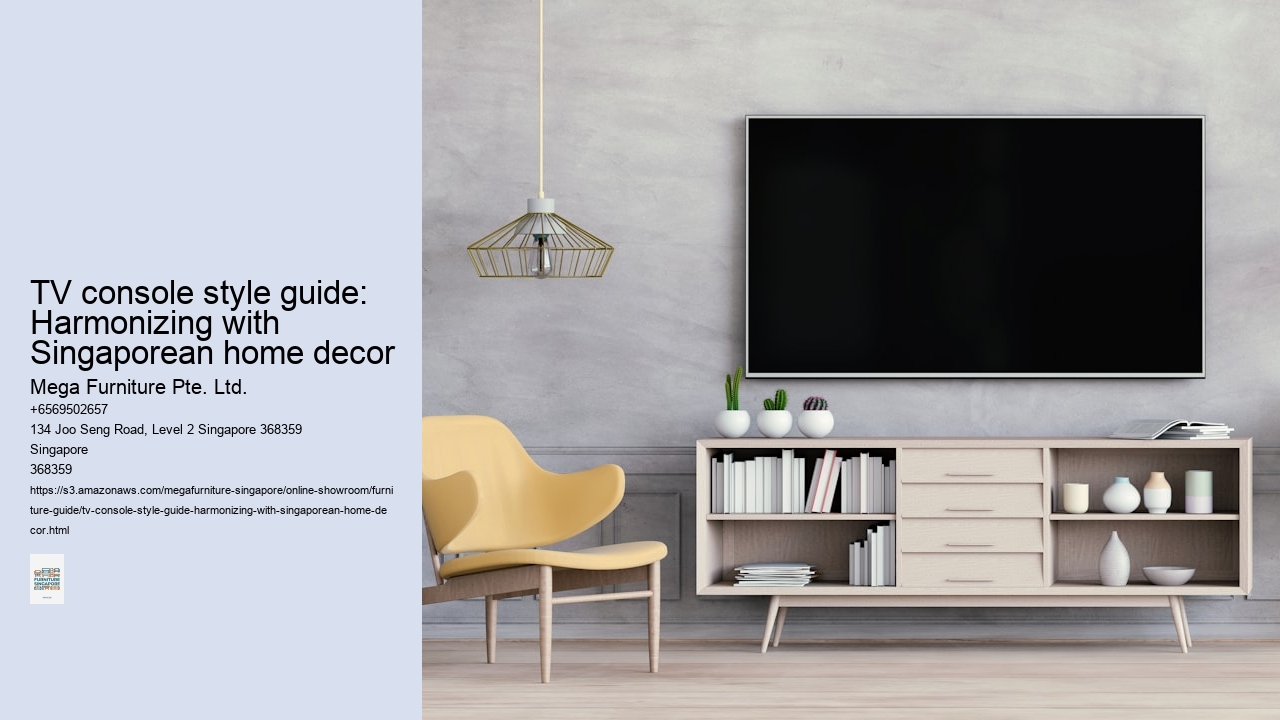
The TV console is the anchor of a Singapore living room, a low-slung cabinet that quietly shoulders the functional weight of the entertainment system. It's a piece defined by its proportions; in a 4-room BTO where the living room wall might be under four metres wide, a console's length is the first calculation. Typical lengths run from 120cm for a 40-inch screen up to 240cm for a 75-inch model - get this wrong, and the whole wall feels unbalanced, like a painting hung too high.
That long, low profile isn't just an aesthetic choice. It's a direct response to the practical realities of local housing, where floor space is currency and clutter is the enemy. The console's primary job is to swallow the visual chaos of modern media: gaming consoles, soundbars, routers, and the inevitable tangle of HDMI cables all get hidden behind cabinet doors or within drawers. A TV console anchors the wall opposite the sofa in the same way a tall bookshelf anchors a corner — long horizontal piece, mix of open and closed storage, defines the visual weight of one whole side of the room. Megafurniture's TV Console range covers floating wall-mounted designs, low-profile freestanding consoles, and modular feature-wall configurations. Most pieces sit at 40-50cm height, sized for screens up to 75 inches.. Open shelving, meanwhile, offers a curated stage for decor - a few books, a ceramic vase, a family photo - which breaks the monotony of a solid front and adds a personal layer to the wall.
You'll find three main variants on the market. Floor-standing consoles are the traditional workhorses, offering substantial storage and stability. Wall-mounted units create a lighter, floating effect that can make a narrow room feel more spacious, while the true floating console, anchored directly to the wall with no visible legs, delivers a sleek, minimalist line that's easy to clean under. The choice often comes down to a trade-off between perceived lightness and sheer storage volume; a wall-mounted piece might force you to be more selective about what you keep in the living room.
Material choices here are telling. Laminates and engineered wood dominate for their affordability and resistance to Singapore's humidity, while solid rubberwood or oak appeals for their heft and grain. A sintered stone top is becoming a popular upgrade - it's virtually indestructible against hot mugs and condensation rings. The console's finish, whether a warm walnut veneer or a matte lacquer in navy or grey, typically sets the colour tone for the entire media wall, acting as a bridge between the TV's black screen and the room's larger furniture pieces.
For many homeowners, selecting the console is less about chasing a trend and more about solving a spatial equation. It's the piece that must reconcile the desired TV size with the actual wall width, while providing a specific type of storage that other cabinets simply don't. You can browse a range of options designed for these local constraints at Megafurniture's collection. The right one doesn't shout; it simply makes the room look organised, and the TV look like it belongs.
The TV console is the anchor of a Singapore living room, a low-slung cabinet that quietly shoulders the functional weight of the entertainment system. It’s a piece defined by its proportions; in a 4-room BTO where the living room wall might be under four metres wide, a console’s length is the first calculation. Typical lengths run from 120cm for a 40-inch screen up to 240cm for a 75-inch model — get this wrong, and the whole wall feels unbalanced, like a painting hung too high.
That long, low profile isn’t just an aesthetic choice. It’s a direct response to the practical realities of local housing, where floor space is currency and clutter is the enemy. The console’s primary job is to swallow the visual chaos of modern media: gaming consoles, soundbars, routers, and the inevitable tangle of HDMI cables all get hidden behind cabinet doors or within drawers. Open shelving, meanwhile, offers a curated stage for decor — a few books, a ceramic vase, a family photo — which breaks the monotony of a solid front and adds a personal layer to the wall.
You’ll find three main variants on the market. Floor-standing consoles are the traditional workhorses, offering substantial storage and stability. Wall-mounted units create a lighter, floating effect that can make a narrow room feel more spacious, while the true floating console, anchored directly to the wall with no visible legs, delivers a sleek, minimalist line that’s easy to clean under. The choice often comes down to a trade-off between perceived lightness and sheer storage volume; a wall-mounted piece might force you to be more selective about what you keep in the living room.
Material choices here are telling. Laminates and engineered wood dominate for their affordability and resistance to Singapore’s humidity, while solid rubberwood or oak appeals for their heft and grain. A sintered stone top is becoming a popular upgrade — it’s virtually indestructible against hot mugs and condensation rings. The console’s finish, whether a warm walnut veneer or a matte lacquer in navy or grey, typically sets the colour tone for the entire media wall, acting as a bridge between the TV’s black screen and the room’s larger furniture pieces.
For many homeowners, selecting the console is less about chasing a trend and more about solving a spatial equation. It’s the piece that must reconcile the desired TV size with the actual wall width, while providing a specific type of storage that other cabinets simply don’t. You can browse a range of options designed for these local constraints at Megafurniture’s collection. The right one doesn’t shout; it simply makes the room look organised, and the TV look like it belongs.